
Otero County Projected Release Dates
The New Mexico Corrections Department uses the formal term Projected Release Date, or PRD. Its projected-release FAQ explains the calculation's changing inputs. Offender Management Services calculates it from the judgment and sentence, presentence confinement credit, the way sentences run, and earned, forfeited, or restored deductions. Part of the calculation may rely on credit already earned and part on credit expected to be earned. The PRD is therefore a forecast. It is not a promise that the person will leave a prison at a set time.
Actual release is the completed custody event. Before release, NMCD performs a file audit that can identify a calculation error, an amended order, a warrant, a detainer, or a release-plan issue. A detainer is a request or legal basis for another authority to hold or take custody of the person. Even when the sentence calculation reaches its forecast date, another valid legal obligation can change the destination or prevent release to the community.
Scheduled versus actual: A projected date estimates sentence completion under current inputs. The agency’s final release record establishes what happened and when.
An ordinary Otero County Detention Center sentence is not calculated by NMCD. OCDC and the sentencing court hold the relevant county calculation and orders. The full Otero County release-record search explains how the court authority and jail departure entry work together.
Find an Otero County Release Date
Begin with the facility, not a broad name search. OCDC is county detention in Alamogordo. Otero County Prison Facility is an NMCD state prison in Chaparral, despite “County” in its name. Otero County Processing Center is an ICE civil immigration facility. A projected state sentence date belongs in NMCD records. A county sentence belongs with OCDC and the court. An ICE movement cannot be calculated from either source.
- Identify whether the person is held by OCDC, NMCD, ICE, or another authority.
- Obtain the current judgment, commitment, and all amended court orders.
- For NMCD custody, search by name or offender number and match more than one identifier.
- Read a public PRD only if the matched detail actually displays it.
- Request the NMCD calculation and pre-release audit when exact verification is needed.
- For OCDC, request the jail sentence calculation and final release disposition.
- Recheck detainers, warrants, court changes, and any supervision plan.
Do not promise that the NMCD public portal always shows PRD. Official policies and forms establish the field, but a live detail may omit it. NMCD’s general release statement also says Central Office, Constituent Services, and the Records Bureau will not provide release updates or statuses. A formal request for an identified Offender Management Services calculation or audit is the traceable route when the public detail is not enough.
Note: A future date is projected, while a past release date still requires confirmation that the listed event was completed by the responsible agency.
NMCD Otero County Release Search
The NMCD Offender Search accepts last name, first name, or offender number. Status controls include Active, Include Inactive, and Absconder Only. Active is the right choice for a person believed to be in state prison or on current state supervision. Include Inactive can find a historical or discharged NMCD relationship. Absconder Only concerns an alleged supervision enforcement status and is not a release-date filter.
The successful manifest capture below shows the official NMCD search and status controls.
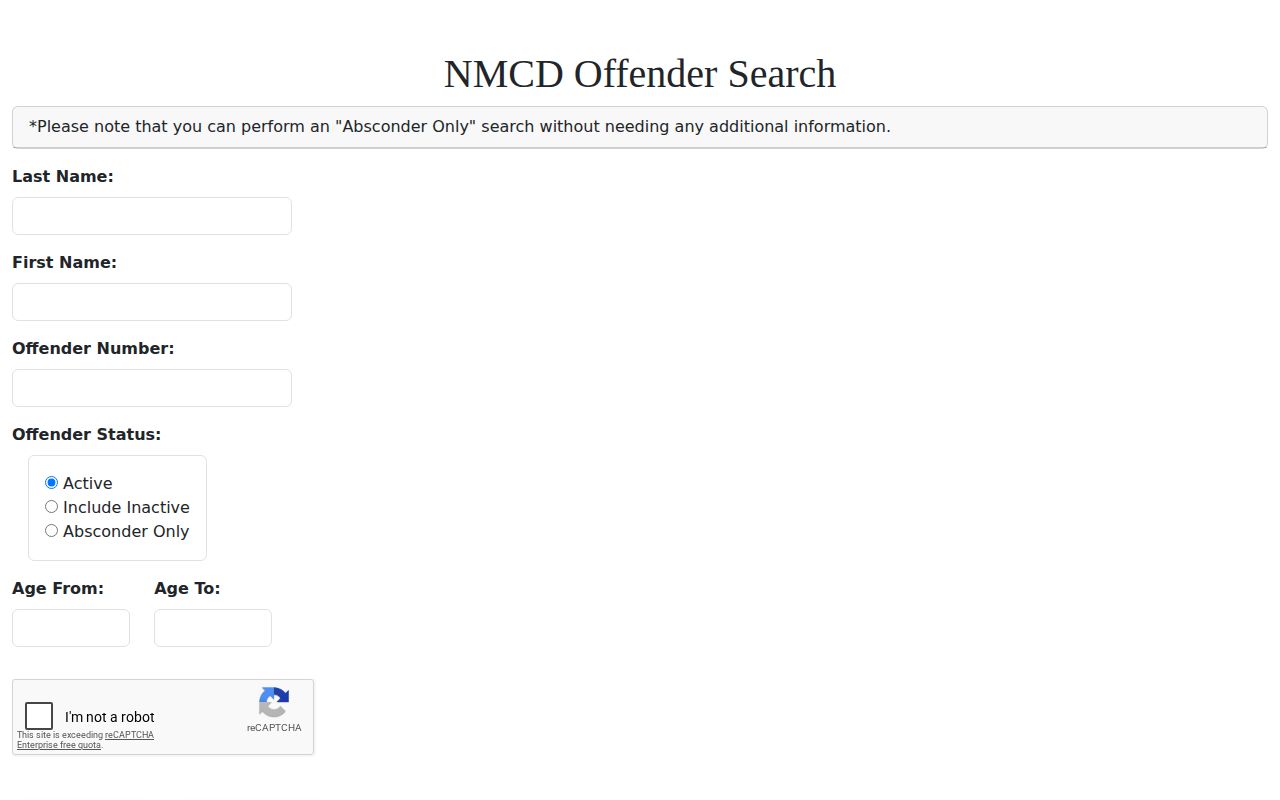
The status choices help locate the correct state record, but the screenshot does not establish a PRD for any individual or promise that every detail displays one.
NMCD says Adult Prison Division information updates nightly and asks users to allow time for processing. Probation and Parole information is described as real time. A person transferred from OCDC to OCPF may briefly sit between reporting steps, so a gap must not be labeled release. Match the offender number, age, aliases, and judgment when possible. An inactive result also does not rule out later county, federal, immigration, or warrant custody.
Otero County Earned Release Credit
New Mexico earned-time law is found in NMSA 1978 § 33-2-34. Under the current framework, after presentence confinement is applied, a person serving a serious violent offense may receive no more than four days of monthly meritorious deduction. A person serving a nonviolent offense may receive up to thirty days per month. The statutory definition controls the serious-violent category. Some offenses require a sentencing-court finding based on the nature and harm, so a charge label alone cannot settle the credit rate.
Life and life-without-parole sentences are excluded from these deductions. Qualifying lump-sum credits may be awarded for listed educational or program achievements and extraordinary conduct, subject to statutory limits and NMCD rules. Monthly and lump-sum credit may also be forfeited, revoked, restored, or changed. Presentence credit, concurrent or consecutive sentences, and amended judgments remain part of the full calculation.
New Mexico does not impose one literal blanket rule that every prisoner “serves 85%.” Four days of credit in a thirty-day month leaves about 86.7 percent before the rest of the lawful calculation. That rough ratio hides presentence confinement, lump sums, forfeitures, restoration, sentence structure, detainers, court amendments, and audit corrections. Use the statute, judgment, and the individual NMCD PRD instead of a slogan.
Why Otero County Release Dates Change
NMCD’s earned-deduction policy CD-080400 identifies several reasons a projected date can move. Expected good time may not be earned. Credit may be forfeited through misconduct. Additional, court, or restored credit may be applied. A pre-release file audit may find and correct an error. The PRD change form also identifies a low evaluation, a lump-sum award, revocation of a deduction, an amended judgment, and other supported grounds. Policy calls for the change to be recorded and communicated through its process.
| Factor | Possible effect on the date | Best record |
|---|---|---|
| Monthly credit | Expected credit may move the forecast earlier if earned | OMS calculation |
| Forfeiture or revocation | Lost credit may move the date later | Credit and disciplinary record |
| Restored or lump-sum credit | Approved credit may move the date earlier | Award and updated calculation |
| Amended judgment | A court change can alter sentence inputs | Filed amended order |
| Detainer or warrant | May prevent community release or change destination | Audit and originating-agency record |
| Final audit correction | Corrected data may move the PRD either way | Pre-release audit |
Parole is another distinct point. A parole decision may allow release from prison under supervision, but it does not equal final discharge from the sentence. Parole terms and eligibility depend on the judgment and governing law. The NMCD record and assigned supervision office should confirm the current status.
OCDC County Release Date Records
A pretrial detainee at OCDC has no earned-time-based completion date. Bond, dismissal, plea and sentence, court orders, and outside holds determine whether and when release can occur. Posting bond starts a process. It does not prove the person has physically left. Another hold can keep the person in custody after one case authorizes release. Pair the court order with OCDC’s actual departure entry.
For a person serving an eligible county sentence, obtain the judgment and commitment order. Ask OCDC records for the jail’s sentence calculation and actual release entry. The requested record should identify the date and time, disposition, legal authority, and destination when those fields exist. That distinction shows whether the person went to the community, transferred to NMCD, moved to another jail, entered treatment or community custody, or was taken by another authority.
OCDC can be contacted at 575-437-6420 for a particular current-location question. The county’s IPRA request process is the documentary fallback. New Mexico’s Inspection of Public Records Act generally calls for inspection as soon as practicable, a written three-business-day timing response when immediate inspection is unavailable, and an ordinary fifteen-calendar-day production or denial deadline, subject to lawful exceptions.
Note: NMCD cannot calculate an ordinary OCDC term, and OCDC cannot certify the projected date for a sentence held by NMCD.
Otero Weekend Release Date Quirk
Otero County weekend commitments make physical absence from the jail an unreliable release signal. A person reports at the time set by the commitment order and may be outside OCDC between required intervals before the sentence is complete. A weekday check that fails to find the person physically housed may therefore reflect the schedule, not discharge. This is the distinctive Otero County release-date issue identified in Research Angle O.
Read the Otero County weekend commitment instructions together with the actual commitment order. The order controls when the person must report. Request the final release entry after the last required interval when the question is sentence completion. Community Custody creates another middle status: a court-approved person may live outside detention on electronic monitoring without unconditional release.
Weekend intervals also show why a roster or phone snapshot cannot replace the record. Physical presence, legal custody, sentence completion, and supervision are separate facts. Ask OCDC whether the person departed, is between ordered intervals, entered community custody, or transferred. Then match the answer to the court order and final jail record.
Confirm Otero County Actual Release
A pending-date alert can be useful, but it remains a secondary channel. Register for the offered event through the Otero County VINELink release check, then confirm with the agency when an alert arrives. Identify the reporting source and timestamp. An automated event can lag or be corrected and does not certify the absence of another hold, transfer, parole term, or probation obligation.
For OCPF or another state prison, request the OMS release audit and related calculation when the exact date matters. NMCD inmate-records policy CD-040100 describes an audit that reviews sentence entries, credits, warrants, detainers, and release-plan needs. For OCDC, obtain the actual departure and disposition entry. For an ICE case at Otero County Processing Center, use ICE ODLS and ERO or case records because leaving the facility may mean release, transfer, or removal.
Resolve a conflict with the office that created the record. A court docket explains legal authority but is not a jail movement log. The NMCD portal supports a state-custody or supervision check but does not cover OCDC-only detention. VINELink reports agency-fed events but is not a certified discharge record. The correct pair is the controlling order or sentence calculation plus the responsible agency’s completed release entry.
Final check: A calculated date answers when release is expected. Only the completed release record answers when custody actually ended or changed hands.