
No Otero 72-Hour Release View
The official Otero County sweep found no rolling 72-hour releases list as of July 29, 2026. It also found no public current jail roster, release-date detail screen, official update schedule, online retention period, published field list, or booking-photo flag. County detention staff may use internal logs, but no verified endpoint exposes those records as a public three-day feed. That gap requires a records-based approach rather than a guess built from a commercial roster.
Otero County’s official sitemap, Detention Center material, Sheriff pages, and inmate-information pages were checked. None supplied a recent-release view. This negative finding should be read with its date because the county could adopt a public system later. Until an official tool appears and its window is tested, no one can responsibly claim that Otero updates a list hourly, keeps names visible for a set term, or includes certain release fields.
Define the Otero Release Window
A three-day request needs fixed start and end points. “Last 72 hours” shifts each minute, while a records custodian must be able to locate an existing record. State the beginning and ending date, clock time, and time zone. For a Monday morning check, for example, a requester can identify the exact Friday morning start rather than ask for an undefined “weekend list.” This method captures a stable period and makes later comparison possible.
Ask for the existing electronic OCDC release log or export for that period. New Mexico IPRA does not require the county to create new analysis or custom statistics. If the requested columns cannot be exported together, ask which existing responsive report, movement log, or release record can be produced. A narrow request is easier to search and less likely to sweep in unrelated protected information.
| Request element | Why it matters |
|---|---|
| Exact start and end timestamps | Fixes the three-day window instead of leaving “recent” undefined. |
| Existing electronic log or export | Requests a record the county keeps rather than a new report. |
| Booking number | Separates people with similar names and ties each entry to one booking. |
| Admission and release time | Shows the custody period and actual OCDC departure. |
| Disposition and authority | Identifies the kind and legal basis of the departure. |
| Transfer destination | Distinguishes release to community from continued custody elsewhere. |
Those are requested release-record fields, not fields found on a county website. OCDC has not published its internal disposition labels. Accept the agency’s actual terminology and ask for clarification when a code or abbreviation is unclear.
Note: Use one time zone and exact endpoints so the custodian can identify a stable Otero County release-record period.
Request Otero Three-Day Release Records
Submit the request through the official Otero County public-records process. Written requests receive the timing protections of the New Mexico Inspection of Public Records Act. The County Manager’s Office is at 1101 New York Avenue, Room 106, Alamogordo, NM 88310. Its published phone is 575-437-7427, and its fax is 575-443-2928. Address the request to the current Records Custodian because personnel and titles can change.
- Name the record holder. Identify Otero County Detention Center and request its existing release log, movement log, or responsive export.
- Fix the period. Give an exact start date and time through an exact end date and time, including the time zone.
- List needed columns. Ask for booking number, admission date and time, actual release date and time, disposition or type, releasing authority, and transfer destination when applicable.
- Choose the format. Request an electronic copy and ask whether that format reduces or avoids copy charges.
- Preserve partial access. Ask the custodian to redact protected parts and produce reasonably segregable nonexempt fields instead of withholding the whole record.
The county’s published process is visible in the captured official request page.
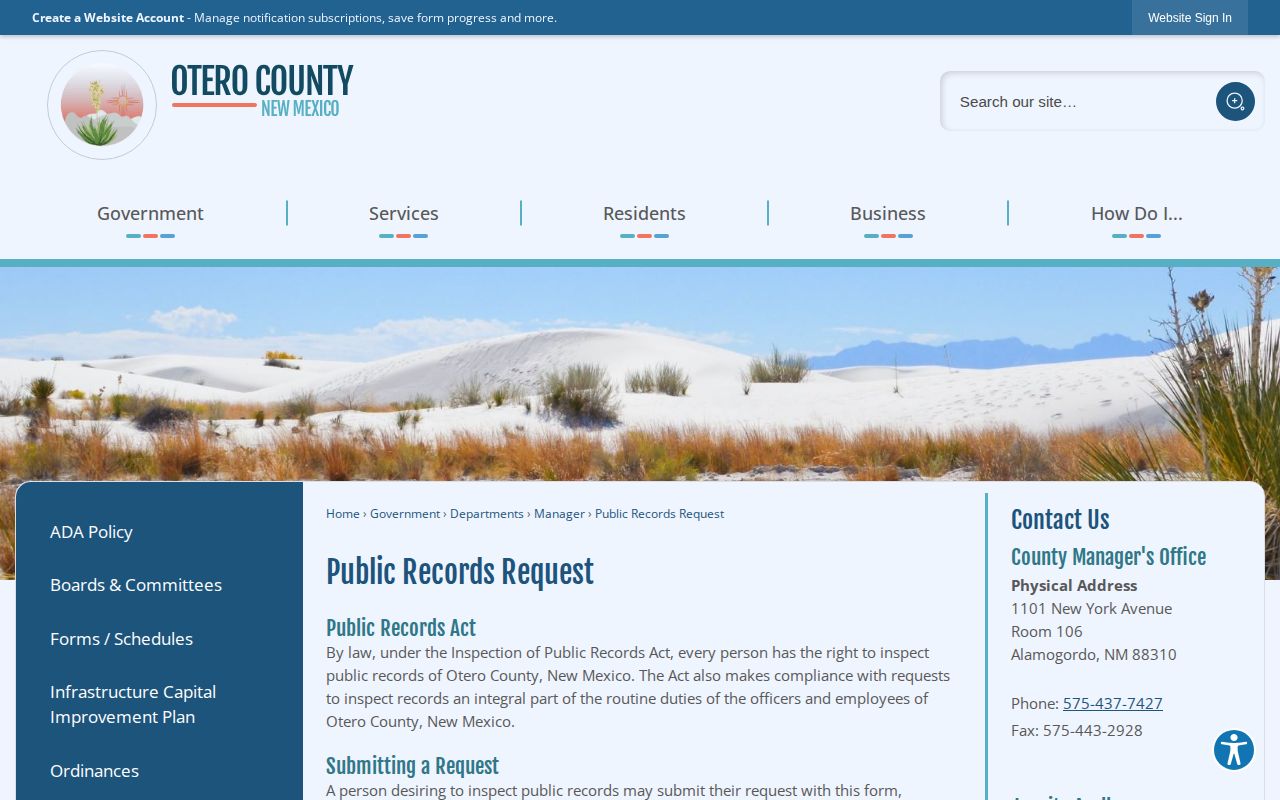
The request route supplies an accountable record even though Otero County does not offer a live three-day screen. Keep a copy of the wording and the county response so the requested period and any redactions remain clear.
Otero Weekend Release Record Gaps
A 72-hour span is most useful when the inquiry crosses days on which online or office activity may be hard to interpret. Otero County does not publish its weekend or holiday release-processing workflow, so no fixed pickup time, release door, family waiting area, or processing schedule should be assumed. The three-day record does not speed a release. It simply catches departures that a shorter same-day question might omit.
Bond posting adds another timing issue. During Otero County’s listed weekday hours, the responsible Municipal, Magistrate, or District Court handles its bond. After hours, OCDC can receive eligible bonds, except Alamogordo municipal-charge bonds go through Alamogordo Department of Public Safety. Posting begins a process. Staff may still verify the order, finish paperwork, check outside holds, or arrange a transfer before physical departure.
Weekend commitments create a different trap. A person may be outside OCDC between intervals set by a commitment order while the sentence continues. That physical absence is not final release. Read the order and request the last release entry before describing the sentence as complete. A 72-hour log must therefore be read with the disposition, destination, and related court record, not as a bare list of names.
Check Otero Releases Across Systems
A date-range log answers who departed OCDC during the chosen period, but it may not answer where each person is now. Verify the next custody system when the disposition indicates a transfer or outside hold. For one named person, the Otero County released inmate lookup provides the full search path without turning a three-day log into a current-location tool.
- Confirm OCDC departure. Call 575-437-6420 and ask whether the person remains housed, departed, or transferred. Call for current information before planning an in-person visit.
- Read the state court case. Search New Mexico Courts Case Lookup for the bond, dismissal, judgment, commitment, release order, or hold that explains the legal authority.
- Use VINELink as an alert source. Search through VINELink and confirm any reported event with OCDC. Agency participation and data lag can affect the result.
- Check state corrections after transfer. Use NMCD Offender Search when state prison or state supervision is plausible. Prison data updates nightly, and NMCD asks users to allow 24 hours.
- Route federal or immigration custody correctly. Use the BOP Inmate Locator for a federal prison sentence and ICE ODLS plus ERO for a person held at Otero County Processing Center.
NMCD has no jurisdiction over ordinary county jail custody. Its silence cannot prove an OCDC release. In the other direction, OCDC records cannot prove release from Otero County Prison Facility because that facility is an NMCD prison, despite “County” appearing in its name.
Read Otero Release Dispositions Carefully
“Released” can describe several legal events. Bond or bail means required financial or recognizance conditions were met and jail processing was completed. Time served means the local custody term ended after the relevant order and credits were applied. A court order can authorize release, but the jail movement entry remains the best proof of when physical custody ended.
Transfer is not community release. A person can leave OCDC for Otero County Prison Facility, another NMCD site, another jail, treatment, or a different authority. Community custody also places an approved person outside the detention center under daily electronic monitoring, so it is not unconditional discharge. Parole ends physical prison custody while legal supervision continues. Probation is a court-ordered community sentence and may follow incarceration.
- Release disposition
- The recorded reason or path by which a person left the holding facility.
- Transfer
- Movement from one custodian to another while confinement or legal custody continues.
- Parole
- Release from prison to community supervision before all legal custody ends.
- Discharge
- The end of a corrections or supervision obligation shown by the applicable record.
The destination field is central. When a log says another agency took custody, search that agency before calling the event a community release. When the field is blank or unclear, ask the records custodian for the meaning of the entry rather than filling the gap with an assumption.
Note: A person who left OCDC may remain confined, supervised, monitored, transferred, or subject to another authority’s hold.
Otero Release Request Timing
New Mexico IPRA states that inspection should be immediate or as soon as practicable, ordinarily no later than 15 calendar days. If inspection is not available within three business days, the county provides a written explanation of when the records will be available or when it will respond. A denial explanation is also due within the ordinary 15-calendar-day period. A broad or unclear request can slow identification of the record, which is another reason to use exact timestamps.
Otero County posts fees of $0.25 per ordinary page through 11 by 17 inches, $0.75 for larger pages, and $4 for each non-document record. Prepayment may be required. An electronic export may be simpler and may affect the charge, so ask before assuming a cost. Juvenile, sealed, expunged, medical, victim-identifying, protected law-enforcement, and security-sensitive content may be withheld or redacted under current law.
A three-day request can produce the best available account of OCDC departures, but the response is historical from the moment it is created. For an event limited to today, use the Otero County 24-hour release check and call the jail. For either period, resolve a conflict with the office that created the record.